Spring Edition

Spring Edition
Spring Edition

Monday, July 2, 2012

Plunge Pools All Day Long

Fishing for small wild native rainbow trout in mountain creeks is not for everyone, it takes a certain person who is willing to put up with bush whacking and descending steep unstable terrain for a 6" trout. Last Friday I finally got a break from guiding to sample 3 of my favorite creeks in Eastern Plumas County; Jamison, Gray Eagle, and Frazier creeks. It's so much fun to drop deep into one of these creek canyons and completely loose yourself for 5 hours, total solitude; Only the birds, bugs, and beasts know you're there.

The wild rainbows of these creeks are beautiful, colors so vivid, and for their size they put up a good fight on the 3wt. Effective flies were Club Sandwich Hoppers, Orange X-Caddis #14, and Yellow Sally stone flies #16. Hatches were light with the Yellow Sally stoner being the most prolific. Terrestrials like hoppers, beetles, and ants will be of the up most importance in the next few months.

All the plunge pools were major homes for the trout, often having a dozen or more fish occupying the area. Water temps ran 54-55.6 degrees! That is what I love about high mountain creekin; Crystal clear cold water. This is where one goes on a hot day to escape the furnace in "The Central Valley", though this summer so far has been mild as was last years was - Climate change is real.


I'm not sure of the name of these spiders but they construct their webs across big boulders right above the creek making a perfect trap for flying aquatic insects. Their web is so strong and gives some problems to fly anglers as these webs block off casting areas. It takes a few casts to punch through the sticky fortress, and thankfully these trout will rise even after you have flogged the water while cleaning out the cobwebs.

This creek at it's head waters is a spring creek with many channels that are deep and full of timber making it very technical. This is a brown trout fishery, the flow is slow and the banks have a barrier of high grass. These fish are spooky and very tough to catch. The brownies range from 6-18". I hooked two that day after some serious stalking, they both spit the hook and that's fine with me; Conservation releases are better for the fish as you do not have to handle them.

This brown trout is tough to see but these were the conditions that you had to deal with; So technical! This brown trout was rooting through the grass knocking off back swimmers and very small aquatic beetles. Wearing camo clothing is a must. This isn't just fishing, your hunting for a wild animal.

If your looking for adventure, solitude, unbound beauty, wild critters, polished granite, and lush foliage it's time you take up Creekin with a small light weight fly rod and your favorite dry flies. Always remember to carry lots of water, the ten essentials, and let someone know what your plan is for that day. You're also going to want to get to the gym are at least be in good shape for this style of fishing as you're not just sitting in a drift boat puffin on a cigar; You'll be where the wild things are, and if you're lucky you will lose all sense of time...

Sunday, June 17, 2012

MFFR Update


The upper river that was so good two weeks ago is entering its Summer mode already. Water temps are now running 62-66.7 degrees. Fish are now located right in the well oxygenated white water of riffles and heads of pools during the day. Royal Trudes #14 worked well for Rick and Dave on Friday. From here on out it will be all about the evening rise. Bring a head lamp and stay till you cannot see your fly anymore. Active bugs now are Golden Stone adults, Little Green Stone, Yellow Sallies, Green Drake duns and spinners, and Pale Evening Duns. The upper section of the MFFR will be done and choke full of algae in a few weeks until the Fall season.

Downstream of Two Rivers (where Jamison Creek enters) water temps are running 58-62 degrees and will fish well for the next month with a emphasis on the evenings. If you want to fish the MFFR you better hurry as conditions will be too warm before you know it.

Sunday, June 10, 2012

Damsel Nation Invades Lake Davis

I did not expect much Saturday at the lake, Colder temps and a good north wind 10-20 mph would not be the greatest of friend to the hatches. As I rolled into the camp 5 parking lot I could see white caps and big water pushing in from the north east. Boaters were already taking out and some men stalled at launching their craft. This day was my only "Jon Time" day, as for the last 6 weeks as I've been burning the candle at both ends working weed abatement and guiding anglers. Despite the cold conditions (gloves and gore tex for the ride out!) I was excited to get out on the boat -  Much needed therapy. I called Pete and he was already fishing Fugawi cove with a few hook ups. "Hey buddy, I'm gonna find shelter and put this wind at my back" I said.

We found a bank along Freeman Creek that provided a "soft window"of water in front of us with a hope of a riser or two. We caught a few fish on blood midge pupa #14 with floating lines. Water temps were 55.6-58.7. The lake has experienced many warm windy days and periods of cold weather with some dusting of snow over the past month. This is good as it stalls out and spreads the good fishing that is coming upon us now for the month of June.

About 9:30 am we started seeing a damsel nymph or two, nothing to get excited about and I was surprised at the time that we even encountered some on such a cold day. I began seeing more as time went on, and now some splashy rises here and there. By 11am damsel nymphs were pouring into our bank, I saw more nymphs yesterday than I ever saw all of last year. It was happening, a hatch was in full swing!

This the most unusual rainbow I have ever caught at Lake Davis, Pete caught one too. No spots as well, who's got a clue? Rainbows ran 17-19 ", clean for the most part, red hot runs and into the backing with a few!

Today was special for we had sight fishing opportunities! I had 12 players in 1-2 feet of water on the mud flats. My theory on why these rainbows come into the mud flats is this; The dark damsel nymphs stick out like a neon flag waving in the wind. I really think they can see them better. Pete had the hot rod of the day and missed so many fish.

There was a line up of boats that formed after we had our spot on the banks. These guys were bangin fish left and right as I saw dozens of fish caught. I did not see any indicators whizzing back and forth and can only guess they were using Int. lines with damsels or blood midge. What was also interesting was the fish were moving in small and large pods from east to west, and west to east in Freeman Creek. These anglers in the boats would have good fishing for a while and then it would shut off, only to get good again. We experienced the same thing on the bank.

Welcome damsel fans, it's showtime now at Lake Davis with daily shows 9am to 2pm. I have no idea how good the hatch will be this year or when it will peak. I know, I know...It's not what it used to be like back in day - Is anything as good as it was back then as far as fishing goes? I do know this - As I age with my fly fishing I'm at the point in my life that quality over quantity is where it's at for me. Seeing the damsel hatch, the fish and birds responding, sight fishing, good friends and trout dogs - Simple pleasures for a simple man.

Sunday, May 27, 2012

MFFR - Prime Time Starts Now!


After a good soaking of rain, thunder and lighting on Friday I flew up the hill early Saturday morning to meet Dan for a glorious day on the Middle Fork Feather. The rains brought the river up about 6 inches from the previous day and the water temps started out at a cold 48.6 degrees. We fished the water around the town of Graeagle and after hitting 3 runs with not a bump I recommended we go to another spot, adding the time traveling will be to our benefit to let things warm up and get going. When we arrived at our our new spot the water temps had already climbed to 51 degrees. I also noticed there was not a fresh foot print to be seen at our new location - "This is a good sign" I said to myself.


Right away Dan was into his first of at least 30 hook ups today, to be honest we lost count - It was that good! Yellow Warblers, Western Tanagers, and many other song birds gave us an orchestra of delightful melodies the entire time on the water, it was the perfect setting for an angler's first time on the MFFR. Dan possessed some serious fly fishing skills which enabled us to really decipher the runs and riffles, breaking it all down and presenting our flies to the correct water. We high sticked nymphs under an indicator with a little lead. Effective flies were PT flashbacks with a clear bead #16, Z Wing caddis emergers #12 in olive, and the San Jaun worm in earth color.


There were so many different bugs out like this March Brown above, PMDs, Green Drakes, BWOs, Little Green Stones, Caddis, and Midges were seen hatching throughout the day. To my delight Ameletus (the brown dun) mayfly nymphs were actively swimming about in the side water, for a bug connoisseur like myself it was the icing on the cake! A few risers were present, but those rainbows really wanted it underneath today.


This is your average sized wild rainbow of the MFFR, fish today ranged from 10-14 inches and full of fight. We had multiple aerial displays right in front us with many fish leaping out of the water more than once.


The fish are stacked up in pods at the tail outs of runs like this one above that had sufficient holding water with depth associated with it. We found different runs produced better than others, often times giving up 3-5 fish in a very small piece of water that would measure 10 x 10 feet.

Today was one of those days where your client can do no wrong, a day I will remember for a long, long time!

Saturday, May 19, 2012

Like Night & Day


What a difference a week can make! Warm temps and plenty of sunshine has baked up some scrumptious conditions on the waters of Eastern Plumas Co.

Lake Davis; Water temps are now running 58-60.5 degrees and the water clarity has vastly improved. The fish are looking up now as I saw numerous rising trout beginning at 8:30am today. Blood midge and the little chartreuse midge (#18) were out in good numbers for a long time. Presenting flies 3 feet down from the surface in 8-20 feet of water got the grabs. Calibaetis are very active as well from 11:30 to 1pm, Z-Lon sparkle nymphs #16 in dark olive/brown was winning. Weeds still have a ways to go but just to see active feeding fish on the surface was a real treat - I'm so ready for some dry fly action! Anglers using indicators seemed to be having the best catch rates, and did even better if they found a nice pod and put the float tube in "park".

MFFR; Water temps are running 52-56 degrees and the flows are coming down and shaping up nicely. The same bugs are out as my previous reports with a few minor adjustments from mother nature. The Gray Drakes seem to be petering out. Golden Stone nymphs are starting to stage on the sides of the river awaiting their emergence. When these stoners get going in a few weeks it is crucial to fish the evening as this is when the majority of the ovipositing is done by the females.

It's been a weird spring altogether for both the lake and river, nothing is quite on cue and some things are early, and some late. It's best to really scan the area you want to fish, make a plan, and be flexible in your approach. What's next week going to bring? Stay tuned...


Sunday, May 13, 2012

Lake Davis / MFFR/ NFYR Update

Lake Davis; Water temps back up to 57 degrees, water clarity still off colored. Fishing was slow for me and others on Friday. Fish are still scattered at all depths but concentrations of them are being found at the Freeman Creek area. Hatches of Calibaetis and Blood midges are increasing and I saw two fish rise while I was out there.

I'm getting outstanding reports for Frenchman's Reservoir in the north end of the lake by many anglers, 10-20 fish days using basic still water flies with a intermediate line.

MFFR; Water levels in the upper river are way down from last week but still a tad high. Water temps are up to 52 degrees. Hatches continue to be good and the little green stone fly was out in big numbers on Saturday. This stone fly is not to be confused with the Yellow Sally, it is a size 12 and hatches mid stream and not on the rocks. A gold bead head PT was working for the emerging stage of the little green stoner. Fishing pressure remains very light

NFYR; Raging and cold! Water temps were 48 degrees. I wanted to wet a line here on Saturday but the flows dictated that it was un-fishable. Another 3-4 weeks away from good fishing here.

Saturday, May 5, 2012

Lake Davis & MFFR Fishing Report


I checked conditions and fished a little bit on 5/3 and 5/4 during a horrendous wind storm that brought some intermittent snow squalls. It was a cold wind and dropped the water temps from 56 to 52 degrees. Water clarity is murky, and the north end is worse around Grizzly creek and Freeman creek. Not many bugs out during my time there, a few Calibaetis and Blood Midge came off but were quickly carried away to the east shore at light speed by the wind. Needless to say I got skunked.


The spawn is winding down and many of the snow melt feeder creeks are getting low. There are still fish ganged up in certain creeks and they may be left high and dry as the flows drop. The good news is that DFG staff and volunteers are doing fish rescues to get them back in the lake, the pelicans will appreciate that.

Current conditions are such; Fish are scattered through out the lake at all depths. You may be lucky and find a small pod at a productive location while fishing, if you do - Stay put! We need warm temps and sunlight to get the aquatic insects going and the weeds to grow; which in turn will get the fish over to the west and north ends. Most of the runoff for the lake is done but Smith peak still has snow so Dan Blough creek will be pumping in some off colored water. I think we are about 3 weeks away for some really good fishing and hatches at the lake, as long as we do not have cold weather come in. 


The Middle Fork Feather River is high and cold, water temps range from 47- 49 degrees. Feeder creeks such as Gray Eagle creek and Frazier creek are running at 44 degrees. There were some incredible mayfly hatches between 1:30 and 3:30 pm. BWO's, Gray Drakes, and March Browns hatched in big numbers. I took the time to watch a small riffle and you could actually see the March Browns "pop" right before your eyes - Really cool! This always happens in the early season of the MFFR, the hatches are there but the water is too cold for anybody to look up.


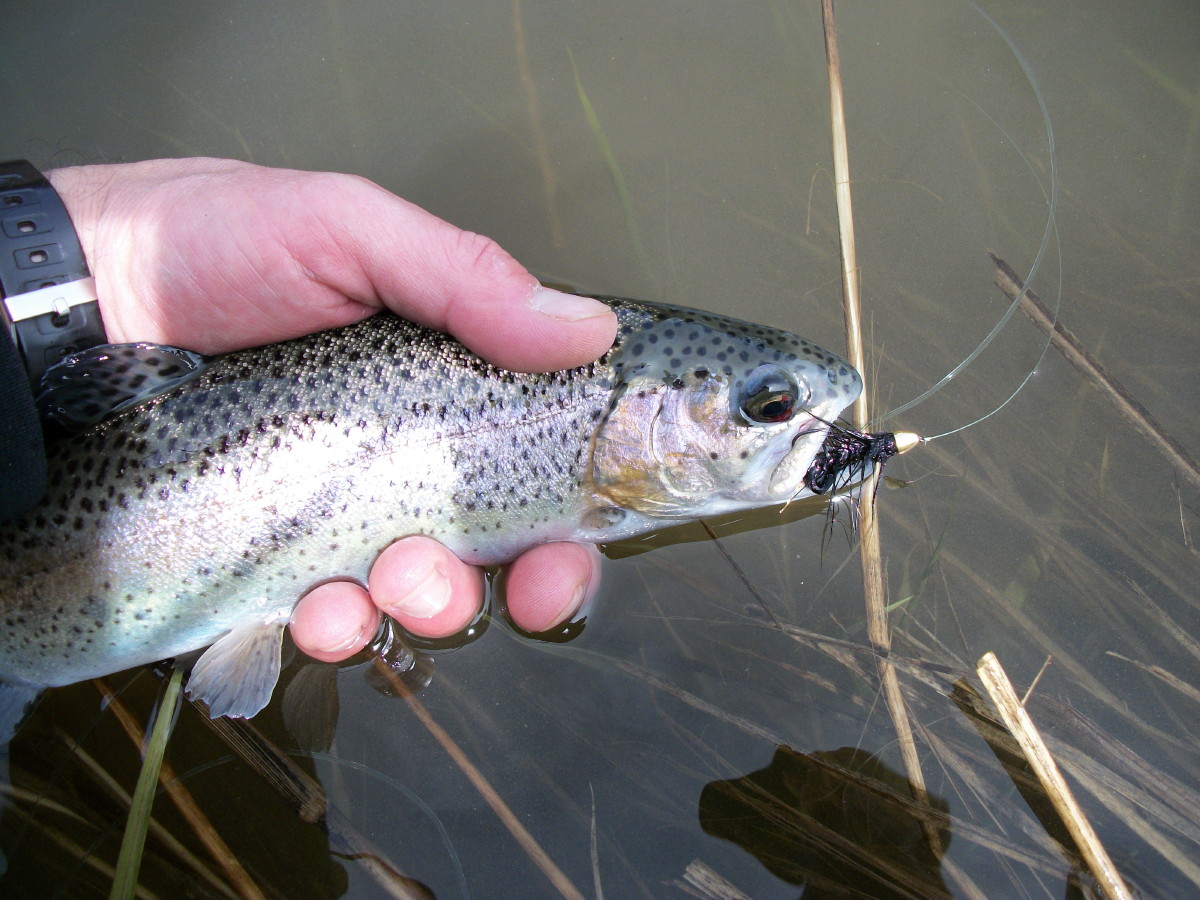
Fishing was surprisingly good despite the conditions. I swung a gold cone head black bugger with a clear camo int. line in the soft water that had some depth to it. Had about a dozen grabs landing 6. Fish ranged in size from 12-16", with one brown at 10", most were fresh planters. Many fish are hanging out where the feeder creeks are coming in but you have to fish the seam of water where the cold water meets the main current of the MFFR.


Here is a tip for you. If you can find side channels like this one above you will find many fish, the water temp here is 51 degrees. With warmer water temps and little flow the fish can feed without working hard against the main flow of the river's current. This particular side channel is about 10 feet deep, I used a Rio express sink tip to get down and had something flash my fly in the 20 inch range! Mr Big did not give me any more chances so I get to have him haunt me at night while I try to get some shut eye. Look for June and part of July to be the most productive time to wet a line here, and hope we do not get any more cold storms so the water temp can come up. Oh, by the way; never saw another angler fishing the entire time. I'll take solitude and  hungry trout anytime!


Thursday, April 26, 2012

Aquatic Entomology Classes for Fly Anglers


Over the years I have noticed a real interest in aquatic entomology by fly anglers who are new to the sport. Understanding the insects and non insects that reside in and around our rivers and lakes will give the newcomer the knowledge it takes to make accurate decisions on fly selections and presentations. This spring and summer I’m offering basic “on site” entomology classes that will shorten the learning curve for students and help them make accurate identifications on the water. I’m team teaching the classes with Christine Elder-a naturalist, educator, and biological illustrator who specializes in entomological illustration. She holds a master’s degree in biology from Humboldt State University, with special emphasis on aquatic ecology and pollination biology. It’s Christine’s experience from the biologist’s perspective that will bring these classes to the next level! For more information and a detailed outline on the class, click on the link. “Knowledge is power”.

Tuesday, April 24, 2012

Trout Radio


Check out my interview for the general trout opener coming this weekend April 28th on many of our rivers in Northern California, It's live with Denis Peirce of KNCO 830am. You'll here about my Spring prognosis and strategies for fishing high run off. It always fun talking to Denis, he's as enthusiastic about fly fishing as I am which makes for a great conversation. You can download and listen to the podcast here; Trout Radio With Jon Baiocchi Just fast forward to the 15:20 mark and enjoy!

Thursday, April 19, 2012

Eagle Lake Spawn - "Close Call"

Picture by Val Aubrey ~ eaglelakefishing.net
Thanks to my antennae at the lake, Val Aubrey (http://eaglelakefishing.net/index.php) kept me in the loop on this year's spawn which was a close call. The health of the fishery derives from CA Fish & Game collecting eggs as the fish enter Pine creek and attempt to spawn, the fish are trapped and the eggs are hatched in the following weeks and returned to Eagle Lake the following year in the 12 inch class. Historically these fish used Pine Creek without help to spawn and the creek flowed naturally. This year little rain reached the lake, and upstream cattle diversions by 5 Dot Ranch took away much of the original flow that should have gone into Pine Creek. The creek started running around the 20th of March and some storms rolled through to help, but it was still only a trickle. The flow picked a little on the 31st and it was enough of a scent to lure the fish staging out in the lake and tell them that it was time to swim upstream. April 7th saw 6 fish enter the trap, 2 of which were ripe hens. Numbers like that are not going to cut it. DFG launched their rescue/special operation plan in times of need like this one, and in the following week they netted over 200 hens to get enough eggs for Eagle Lake with some extra to go around! Whew! Close call! If your concerned as I am about saving the heritage trout, you can help and join the Eagle Lake Guardians by clicking the link and become a member for $15  http://www.eaglelakeguardians.org/ or download the membership application and send it in. http://eaglelakeguardians.org/imagecp/pdf/EAGLE%20LAKE%20GUARDIANS%20MEMBERSHIP%20APPLICATION%202012.pdf

Tuesday, April 17, 2012

Tying The Freshwater Shrimp


Gammarus lacstris or known to fly anglers as scuds are a semi translucent Crustacean that Eagle Lake trout prefer to dine on. They can be quite large ranging in sizes 10-16. Their habitat is amongst the rock piles in shallow water, the lava rocks of Eagle Lake offer even better habitat with the tiny pockets of recessed holes. They mate several times a year and offspring are hatched from eggs and are a micro sized form of the adults. They range in colors that match their surroundings for camouflage since they have no natural defense mechanisms. At Eagle Lake they can be found in these primary colors; light brown, olive, and when molting grayish blue. Orange scuds are not dead scuds but pregnant females, the eggs color shows through the translucent body. The trout can really key in on these orange scuds so always have a few of them in your box. Being scavengers they comb their surroundings eating plant and animal materials that have settled on the bottom. The experts say they have a negative reaction to light but I have seen first hand that these little critters can be active during bright conditions. Analysis provided by the Chico State field lab have determined that the scuds make up 40% of the Eagle lake rainbow's diet and provide a high value of protein  that makes these fish grow big and fast.


It's habitat like these rock piles above that draw in the Eagle lake rainbow. The observant angler can spot smaller rocks in the shallows that have been flipped over by the fish while they vacuum up scuds. The best way to present these flies is to cast into the shallows and retrieve the fly with short semi fast strips of line with plenty of pauses. Scuds swim backwards like a cray fish, keep this in mind when tying your imitation. You can also hang a scud pattern under an indicator and present them over the rock piles while anchored or free floating.


RECIPE:

Hook:  Tiemco 2457 #10-16.
Thread: 6/0 Uni thread color to match.
Tail / Antennae & Legs:  Jay Fair Schlappen hackle tips .
Body:  Buggy dubbing mixed with some Antron fibers, color to match.
Note:  Pick out the underside of the fly with a bodkin.  

Wednesday, April 11, 2012

Respect Needed for Lake Davis Rainbows


 As another spring approaches on the shores of Lake Davis, rainbow trout do what comes naturally; they seek out feeder creeks with fine gravel to spawn. There are many snow creeks that come into the lake and all but Grizzly creek will dry up before the fry can get back into the lake. It is estimated that only 2 percent ever will.

For years anglers have fished at these inlets of water that pour into the lake where fish gang up and stage before making their journey upstream. In my youth I did it myself. But there comes a time when an angler has a soft spot for these fish, after all they just want to produce offspring and go on their way into the fertile weed beds and graze. How sporting is it to fish for them at these times? I guess if you have a big ego and want numbers then you can overlook it all and say “Well, I’m just fishing” as many do.

There is no law that says you can’t practice this. Lake Davis has a limit of 5 fish, and 10 in possession; it is after all a put-and-take fishery. An angler can have just as much fun and success fishing on the points that are near the feeder creeks without the guilt of being greedy. People want it the easy way, the way our society has programmed us with fast food and other services that can make a person lazy and not think outside the box.

Even more disturbing is some people will take these fish without even using a fishing pole in their hands; they use a net as they scoop them up out of the creeks and fill up the garbage bag heading for home. This practice is illegal; it’s called poaching! Only once have I seen these culprits arrested but what a fine show it was by the California Department of Fish and Game. In this case a warden was in the middle of the lake using binoculars and spying on the guilty party as they netted these vulnerable fish in the skinny water of a creek. Equipment was confiscated and tickets written. There is decent cell phone coverage at the lake and I urge all anglers if they see this type of activity to walk away and say nothing to these law-breaking people and call the California Department of Fish and Game’s CAL-TIP at 1-888-334-2258. As many of you are aware the Department is under-staffed with wardens and many of them have a huge area to patrol. They can’t be everywhere at once and this is where concerned anglers come into play by helping out.

In my opinion the regulations should be changed to protect these fish so that all anglers have a fair chance at them. Closing the lake from March 1st to May 15th could be a viable solution. This way ice fisherman could still be able to fish through the winter months, and the fish would get a much needed break between the dates mentioned. Another possibility is to close off the creeks with structures that would not allow upstream migration; sounds simple right? All this takes time and money, and with state budget cuts the fish lose and the poachers win. Responsible anglers will hold the future of our state’s waters. I hope you can be one of those anglers and think of the fishery first so that other anglers can enjoy the rewards of catching the big one at Lake Davis.

Wednesday, April 4, 2012

MFFR Opener 4/7/12


This coming Saturday the wild & scenic Middle Fork Feather River opens from the A-23 Bridge 4 miles east of Portola down to the Mohawk bridge downstream of Graeagle.  Though fishing will not be red hot, it does give anglers a chance to get out and fish some moving water.  The trout of the MFFR do not respond well to flies as other rivers do when water temps are 40-50 degrees (think Truckee River).  But this time of year is when I do catch bigger fish who are on the move.


For some reason I also catch more brown trout at this time of year, especially close to the town of Portola.  Tactics for early spring is deep nymphing with something big and plenty of split shot on your leader to get down.  You're going to want to use heavier tippet than normal.  The flows are high and water clarity off color as well, 3x (rope) will do just fine.


The Golden Stone rubber leg is a great searching fly, the nymphs are always present in the system and the trout are accustomed to seeing them on a regular basis.  High sticking/short line nymphing with or without an indicator will produce results.  Depending on the weather there may be some light hatches of March Browns and the Gray Drake.  Dark pheasant tail nymphs in a size 10 for the drake, and size 14 for the March browns may work if water temps cooperate.  If you do see rising trout for these hatches consider yourself lucky, this does not happen to often in the early season on the MFFR.


My favorite thing to do in early spring on the MFFR is to swing streamers with a sinking line.  For deep water a express sink tip is preferred, and in shallow water a clear camo Intermediate line will do well.  Minnow patterns 2-4inch long are best but a bead head black wooley bugger has been effective as well.  After your swing is complete in your target area strip the fly back aggressively, this is when I get the most hook ups.  What ever game you decide to play look for trout to be in the tail outs of runs and don't forget about back eddies and sloughs.  All these water types have warmer water and less flow, the trout do not have to work so hard for their preferred meal.

If you plan on going I wish you the best of luck, and be sure to leave a few for me!

Tuesday, March 27, 2012

Kiene's 2012 Expo


I'm passing this along from Aaron Stiny From Kiene's Fly Shop;

The Expo preparations are coming together and it looks like this year is going to be bigger and badder than ever! Come by and say hi to us, reps, and people from all over the industry. There will a ton of gear to test drive! As usual some of the top fly tiers in Nor Cal will be present and we also have a full batch of great slide show presentations in the works. This year we'll have more top Nor Cal guides than ever in attendance to bs with and pick their brains for tips on their local waters. As always there will be a ton of high end schwag to raffle away!

Some highlights:
Casting presentation and instruction from Rachel Andras...need we say more! Also Tony Yap will instruct on casting for distance and accuracy.

Fly Tying:
All of the usual suspects are back! 
Jay and Glenn Fair will be on hand again this year with more new materials.
Neal Pultz 
Jay Murakoshi
Ken Hanley
Bob Sheidt
Mike Henle 

Top Nor Cal guides:
A lot of folks will be on hand, take advantage of this to learn more about their home waters.
Keith Kaneko
Lance and Lincoln Gray
Confluence Outfitters
Capt. Mark Brown
Jay Clark 
Jon Baiocchi
Darrin Deel 
Jim and Rachel Andras (Andras Outfitters) 
Brian Slusser
Bill Ferrero
Rob Anderson & Doug Ouellette
Confluence Outfitters
Jason Hartwick
El Capitan Maury Hatch 
and more!

Additionally the crew from the Tahoe-Truckee chapter of Trout Unlimited will be on hand to talk about their success and future goals with the watershed. Tahoe Trout Bum Schwag will hopefully be available for purchase. 

If nothing else come have a free hot dog and soda and enjoy.


So there you go, for more info contact the great staff at Kiene's Fly shop;
http://www.kiene.com/  (800) 400-0359

Thursday, March 22, 2012

Tying The March Brown Sparkle Comparadun


Genus Rhithrogena or the “March Brown” mayfly as fly anglers like to call them is an important spring time hatch for trout. It's easy to get excited about these bugs, presenting a big mayfly on the surface to a wary consumer is really what fly fishing is all about. If you have ever rolled rocks on your favorite river I'm sure you've seen these aquatic insects before. March Browns are in the "clinger" group of mayflies, they are very flat and wide with feathery gills protruding off their abdomen.  Their head and extremely large eyes look like an alien from another dimension. They make their home in the fast turbulent riffles of a river, their body profile and gills helps them stick to the rocks by way of a suction disc underneath their body so they are not carried off by the strong currents.

The actual hatch takes place during the warmest point of the day. It is at this time that the nymphs leave the bottom substrate by way of gas bubbles trapped underneath their wing pads which lift the nymph to the surface.  These gas bubbles also help split the exoskeleton for the emergence from nymph to dun. As the mayfly struggles to free itself from its shuck it is very vulnerable to an opportunistic trout.  Many times trout will key on this stage of the emergence only, and this is where the Sparkle Comparadun shines most brightly!

This fly is a must on rivers that have very sophisticated trout, you know the ones that haunt you at night when you’re trying to go to sleep and all you can think about is "Why wouldn't they take my fly"?  What I like most about this pattern is that it is a quick and easy 3 step twirl of the bobbin.  Shuck, body, wing, whip finish and you’re done!

The March Brown mayfly will be appearing at a river near you for the next month and maybe longer depending on your elevation. Stock your fly box now with nymphs, emergers, and dries before you head out on the open waters. 


RECIPE:

Hook:  Tiemco 101 #14.
Thread: Camel colored Uni Thread in 6/0
Trailing shuck:  Dun colored Z-Lon touched up with a brown sharpie.
Body:  Very fine brown dubbing mixed with some Antron fibers
Wing:  Dark moose or elk hair, make sure the height wing is as long as the body.

Note:  You can match many different mayflies with this pattern in sizes 12 and smaller by adjusting the size and the colors of the shuck, body, and wing.

Monday, February 20, 2012

The Skwala Nation

The Skwala Americana stonefly is from the Perlodidae family and the first big stonefly trout see as spring approaches.  They range in size from 21mm-28mm and the female is noticeably bigger than the male.  Colors of the Skwala are different from watershed to watershed, but most will have a drab brown-olive to black body and head, with soot yellow markings on the abdomen, and a smokey dark wing.  The emergence can start in mid January in our valley rivers, and March or April in the mountains.  The nymphs clumsily swim over to the bank and crawl out to split it's exoskeleton under rocks that have livable spaces.  Much of the mating occurs here and this stoner is not like most others.  The female crawls onto the side water of a river and floats down placidly ovipositing, to many anglers they look like little twigs floating by as the Skwala does not beat it's wings while egg laying.  This is when the trout move into the side water looking for where the current pushes these bugs and concentrates them in the feeding lanes.  Late afternoon is the time to fish until just before dark, the warmer the temp the better.  I can't say this enough, observe before you cast and find the naturals on the water, then look for active fish (Skwala Eaters) keying in on them and rising.  These fish can get picky as pressure from armies of anglers pound the water (Lower Yuba), and at times a fly first presentation or a lighter tippet may be needed to fool them.

I thought I would share a few patterns that have been doing well for me, but as always I'm constantly trying different materials and ideas to see what they will and will not take - Tweaking to find the perfect Skwala.


This is my all foam Skwala I modelled after my club sandwich hopper, it floats well but what I like about a all foam pattern is that the trout seem to chew on this a bit longer allowing you to get away with a late hook set.  As with all Skwala patterns a black sharpie felt pen works wonders to get that yellow foam nice and sooty.


This is the underside of the Skwala sandwich, it gives a good profile, segmentation, and the rubber legs give the fly some movement.


This Skwala pattern is taken from Doug Swisher's Madam X fly or Bruce E. James's Black Legged Waterwalker and is used when trout start refusing patterns.  Most Skwala patterns are dark so adding a bit of white or yellow foam helps to see it on the water.  Keep the "sight" foam cut low so it does not protrude out and spook the trout.


Since most of the adults we see on the water are females laying eggs, it helps to add a oversized peice of foam protruding off the back replicating an egg sack, these are the things an experienced skwala eater will look for when trying to decipher the real thing to an artificial fly.  The more one observes of the natural and brings it back to the tying vise, the more succesful one is when presenting the Skwala adult dry.  Good Luck!

Tuesday, February 7, 2012

Mendocino-Tahoe Conservancy Memorial Benefit

A birthday celebration in memory of conservation pioneer John Olmsted will be held March 2nd at St. Joseph’s Cultural Center in Grass Valley.


Organized by, and a benefit for the Mendocino-Tahoe Conservancy who is continuing John’s mission of protecting wildlands and creating trails. Performers will include a host of wonderful local entertainers including funky dance band, Power of Twelve. Other entertainment will include poetry readings by Molly Fisk and Maxima Kahn, a juggling comedy show with Locomotion Circus, harp and songs by Tynowyn & Rossignol, and a slide show featuring a hiking adventure along the Olmsted Cross California Trail and performance of songs by Riparia, written on the trail and inspired by its natural beauty. Purchase tickets and learn more about the Mendocino-Tahoe Conservancy at http://www.mendotahoe.org/events.html.


Please join us and enjoy a fun filled evening that supports many trails to your favorite trout filled rivers and lakes in Northern California!


Total Pageviews